
In today’s fast-paced transportation industry, fleet operators face high stakes when it comes to compliance with regulations. The financial ramifications of compliance failures are staggering. The average fines issued by the Federal Motor Carrier Safety Administration (FMCSA) are around $5,000. This amount is minor compared to the astronomical nuclear verdicts that can exceed $10 million. Such verdicts can threaten the survival of many small and mid-sized fleets. Violations related to the drug and alcohol clearinghouse can lead to daily penalties of $10,000. This emphasizes the urgent need for vigilance in compliance management.
As the U.S. commercial auto sector contends with 13 consecutive years of underwriting losses, maintaining adherence to regulations is more critical than ever. Fleet operators must recognize that navigating the compliance maze is not merely a legal obligation. It is also a strategic imperative that can protect their financial future.
Financial Risks of Compliance Failures
The financial risks associated with compliance failures are profound, and they extend beyond mere fines or penalties. In the realm of transportation, fleets face significant threats from nuclear verdicts, operational shutdowns, and other costly repercussions of non-compliance. Nuclear verdicts, which are increasingly common, can exceed $10 million, serving as a wake-up call for fleet operators who underestimate the gravity of regulatory adherence.
Moreover, the average fine issued by the Federal Motor Carrier Safety Administration (FMCSA) after an audit is around $5,000. While this may not seem burdensome at first glance, the accumulation of fines, especially for small and mid-sized fleets, can swiftly escalate to unbearable levels.
Additionally, compliance failures can lead to operational shutdowns, as companies face increased scrutiny and regulatory action. For instance, violations in areas such as drug and alcohol testing compliance, driver qualification, or hours-of-service rules can trigger severe consequences. Each day of non-compliance can cost businesses dearly; penalties related to the drug and alcohol clearinghouse can amount to $10,000 per day up to a maximum, emphasizing the critical need for fleets to ensure stringent compliance protocols.
Furthermore, record-keeping violations can range from $1,000 to $15,000 or more per violation, compounding financial risks. The reality that the U.S. commercial auto sector has endured 13 consecutive years of underwriting losses highlights the severity of these risks. Thus, it is imperative for fleet operators to treat compliance not only as a legal obligation but also as a crucial financial strategy to mitigate potential losses that could threaten their existence.
By understanding these financial ramifications, fleet operators can better appreciate the importance of robust compliance management systems and seek the necessary training and resources to protect their bottom line.

An illustration depicting financial loss from compliance failures in a fleet, featuring an overturned dollar sign, broken chains of compliance, and a distressed fleet of trucks.
Costs of Regulatory Lapses
The costs associated with regulatory lapses in fleets extend far beyond fines. Clearinghouse violations not only disrupt operations but also carry hefty penalties, potentially amounting to $10,000 per day, which can severely impact a fleet’s financial health. Additionally, record-keeping violations pose another significant risk, with potential costs ranging from $1,000 to $15,000 or more per violation.
These financial ramifications can accumulate quickly, driving small and mid-sized fleets into precarious situations. The loss of revenue stemming from daily fines, coupled with the potential for nuclear verdicts and operational interruptions, underscores the pressing need for meticulous compliance management. Failure to adhere to regulations can lead not only to direct financial penalties but also to longer-term business repercussions that threaten a fleet’s very existence.
Comparison of Compliance Violations and Penalties
| Compliance Violation | Description | Penalty Range |
|---|---|---|
| FMCSA Audit Violations | Fines resulting from audits by the Federal Motor Carrier Safety Administration (FMCSA). | Average of $5,000 per audit. |
| Clearinghouse Violations | Violations tied to the drug and alcohol clearinghouse requirements. | $10,000 per day, up to maximum. |
| Record-Keeping Violations | Failure to maintain proper records as required by regulations. | $1,000 to $15,000 or more per violation. |
| Hours-of-Service Violations | Non-compliance with driver work hours requirements. | Varies; can lead to significant fines and operational disruptions. |
| Driver Qualification Violations | Not meeting standards for driver qualifications. | Varies; potentially severe penalties including fines and legal action. |
This table highlights the varying degrees of penalties associated with compliance violations in the fleet industry, emphasizing the financial stakes involved in effective compliance management.
Compliance Failure Case Studies
In the realm of transportation, compliance failures can result in catastrophic financial consequences. These failures often lead to substantial jury verdicts, termed “nuclear verdicts,” which can exceed $10 million. Notable experts like Joel Sitak and Brandon Wiseman emphasize the severe risks associated with these lapses.
-
Kahkashan Transportation Inc. Verdict (2021)
A landmark verdict against Kahkashan Transportation Inc. highlighted the perils of compliance failures. The case involved the tragic death of an 18-year-old due to an improperly qualified driver operating beyond allowed hours. The jury issued a staggering $1 billion verdict, with $900 million designated for punitive damages, illustrating how regulatory failures can lead to devastating financial implications.
-
Mechanical Failure Verdict (Texas, 2012)
In a case where a commercial truck’s drive shaft detached, resulting in a fatal accident, the court awarded $281.6 million—later reduced to $105.2 million. The case underscored critical failures in vehicle maintenance, reinforcing the importance of compliance in operational safety.
-
Schnitzer Southeast Verdict (2016)
A driver falling asleep behind the wheel led to a $280 million verdict against Schnitzer Southeast. This case exemplifies the dire consequences of inadequate fatigue management and Hours of Service (HOS) compliance, highlighting vulnerabilities that can lead to substantial penalties.
-
Werner Enterprises Verdict (2018)
In Texas, a jury found Werner Enterprises liable for a collision during icy conditions, awarding $90 million. The case demonstrated compliance failures in training and operational decision-making, especially concerning inexperienced drivers.
Experts like Brandon Wiseman caution that non-compliance can lead not only to financial losses but also to increased insurance premiums and the potential for operational shutdowns. Joel Sitak warns, “For many small and mid-sized fleets, a single incident tied to poor compliance management can threaten the survival of the entire business.”
Additional Compliance Case Study
-
JHOC Inc. Verdict (2018)
A 2018 California case resulted in a $58.5 million verdict against JHOC, Inc., involving a possibly impaired trucker who lost control and caused a fatal collision that killed a mother and her two children. While driver fatigue was also cited, potential impairment, exacerbated by compliance failures in drug and alcohol testing protocols, significantly tilted the verdict against the company.
These case studies vividly illustrate that the stakes of compliance management extend beyond regulations; they are fundamentally tied to the survival and profitability of fleet operations. Failure to adhere to compliance can result in significant financial repercussions, underscoring the need for robust compliance systems in the transportation sector. By prioritizing compliance management, fleets not only protect themselves from liabilities but also ensure their long-term viability in a competitive market.
Impact of Compliance Failures on Insurance Premiums
Compliance failures in the fleet industry directly influence insurance premiums, creating a complex web of financial risks. When fleets fail to adhere to regulatory standards, they not only incur fines and penalties but also face increased costs for insurance coverage. Insurers evaluate a fleet’s compliance history when determining premium rates, and fleets with records of violations are seen as high-risk, leading to inflated premiums.
Additionally, compliance failures result in points being added to safety scores, further influencing insurance rates. A poor safety score can signal to insurers that the fleet is more likely to experience accidents or incidents, prompting higher premiums.
Moreover, the potential liabilities from nuclear verdicts and operational disruptions associated with compliance lapses are also factored into the insurance equation. These potential financial exposures lead insurers to adjust premiums upward, reflecting the higher risk associated with fleets failing to meet compliance standards.
To mitigate insurance costs, fleets must adopt proactive compliance management strategies. By ensuring adherence to regulatory requirements, fleets can not only avoid fines but also stabilize insurance premiums, making compliance a crucial aspect of financial strategy.
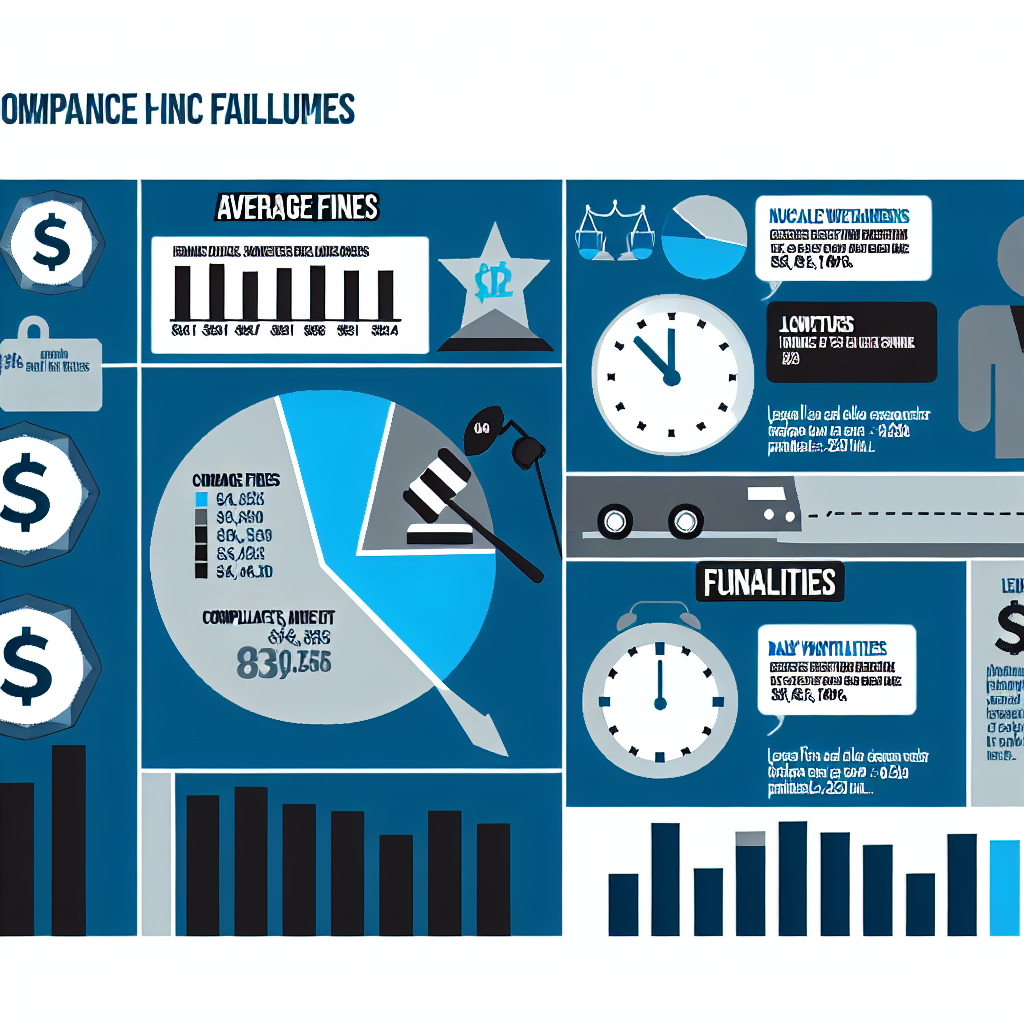
An illustration showcasing key statistics related to compliance failures in the trucking industry, featuring icons representing fines, lawsuits, and significant financial facts such as average fines, nuclear verdict amounts, and daily penalties.
Conclusion
In conclusion, the necessity of compliance in fleet operations cannot be overstated. The financial repercussions of non-compliance are staggering, as demonstrated by the phenomenon of nuclear verdicts that can exceed $10 million, along with the more mundane yet impactful fines that can accumulate swiftly.
For fleet operators, these consequences are not just theoretical; they pose real threats to business viability. Therefore, taking proactive measures towards compliance management is critical. This involves instituting rigorous training programs, regular audits, and a commitment to adhering to regulatory standards.
The stakes are high, and the cost of inaction is steep. By prioritizing compliance, fleets can protect their financial health, safeguard their reputation, and ensure long-term operational sustainability. In a world where regulatory landscapes are constantly evolving, the time to act is now.
Experts like Brandon Wiseman caution that non-compliance can lead not only to financial losses but also to increased insurance premiums and the potential for operational shutdowns. Joel Sitak warns, “For many small and mid-sized fleets, a single incident tied to poor compliance management can threaten the survival of the entire business.” This statement encapsulates the gravity of compliance management and its critical role in safeguarding the future of fleet operations.
Avoiding Costly Compliance Traps: Safeguard Your Fleet’s Financial Future
Introduction
In today’s fast-paced transportation industry, fleet operators face high stakes when it comes to compliance with regulations. The financial ramifications of compliance failures are staggering. The average fines issued by the Federal Motor Carrier Safety Administration (FMCSA) are around $5,000. This amount is minor compared to the astronomical nuclear verdicts that can exceed $10 million, which underscore the seriousness of compliance violations. Such verdicts can threaten the survival of many small and mid-sized fleets due to the legal and financial fallout from non-compliance. Violations related to the drug and alcohol clearinghouse can lead to daily penalties of $10,000. This emphasizes the urgent need for vigilance in compliance management.
As the U.S. commercial auto sector contends with 13 consecutive years of underwriting losses, maintaining adherence to regulations is more critical than ever. Fleet operators must recognize that navigating the compliance maze is not merely a legal obligation. It is also a strategic imperative that can protect their financial future and help manage insurance premiums, which can skyrocket due to compliance failures.
Financial Risks of Compliance Failures
The financial risks associated with compliance failures are profound and extend beyond mere fines or penalties. In the realm of transportation, fleets face significant threats from nuclear verdicts, operational shutdowns, and other costly repercussions of non-compliance. Nuclear verdicts, which are increasingly common, can exceed $10 million, serving as a wake-up call for fleet operators who underestimate the gravity of regulatory adherence.
Moreover, compliance violations can lead to operational shutdowns, as companies face increased scrutiny and regulatory action. Each day of non-compliance can cost businesses dearly; penalties related to the drug and alcohol clearinghouse can amount to $10,000 per day up to a maximum, emphasizing the critical need for fleets to ensure stringent compliance protocols. The record-keeping violations can range from $1,000 to $15,000 or more per violation, compounding financial risks and affecting insurance premiums. The reality that the U.S. commercial auto sector has endured 13 consecutive years of underwriting losses highlights the severity of these risks. Thus, it is imperative for fleet operators to treat compliance not only as a legal obligation but also as a crucial financial strategy to mitigate potential losses that could threaten their existence.
By understanding these financial ramifications, fleet operators can better appreciate the importance of robust compliance management systems and seek the necessary training and resources to protect their bottom line.