
Repairing Jaguar vehicles, particularly for fleet managers and operators in logistics or construction, requires a precise understanding of potential costs. This article delves into various factors affecting the overall repairs, including common engine problems, labor associated with repairs, diagnostic challenges, and the importance of preventative maintenance to mitigate future expenses. Each chapter aims to provide actionable insights that help you navigate the complexities of maintaining your fleet efficiently and economically.
null

null
How Much to Repair a Jaguar? Demystifying Engine Costs and the Myth of a Jaguar Truck
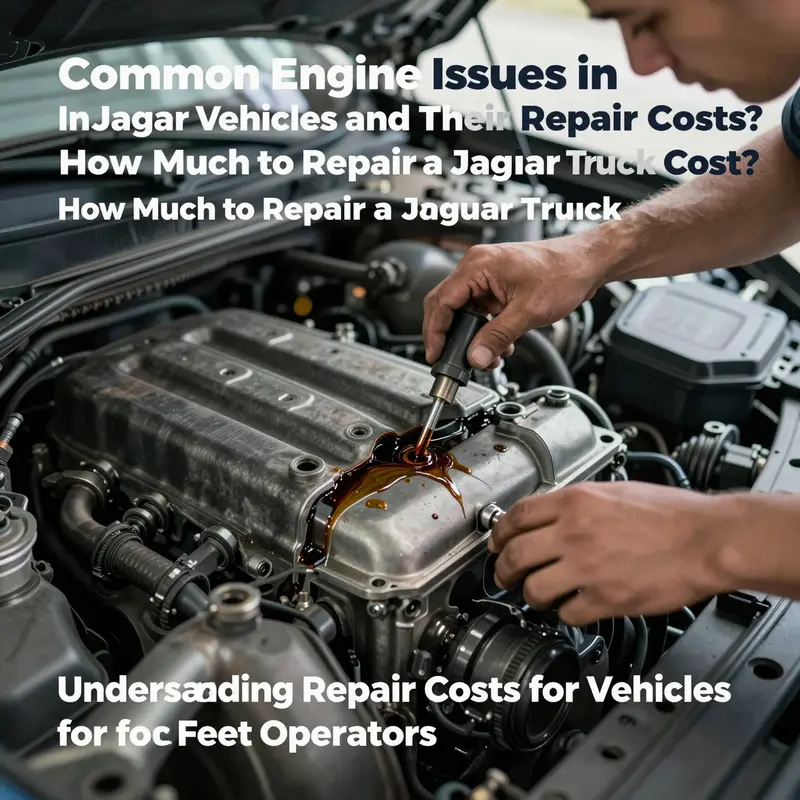
When people start digging into the question of what it costs to repair a Jaguar, they often stumble over a stubborn misconception: Jaguar has never built a line of trucks. The brand’s heritage is luxury cars and SUVs, not commercial haulers. The cost to fix engines in modern Jaguars can be surprisingly variable, and the path to a fair bill starts with precise diagnosis. The Ingenium 2.0-liter turbocharged engine is common in many recent Jaguar and Land Rover models, and it often drives the price discussion. This chapter unpacks where those costs come from, why some repairs look astronomically expensive, and how a careful approach can prevent paying for work you do not actually need. It also anchors the discussion around the Ingenium family before broadening to common engine repair themes.
A frequent oil leak in Ingenium engines is not usually a massive seal failure but a small rubber plug near the back of the engine. Replacing the plug plus labor commonly runs about 150 to 300 dollars. That is a fraction of the cost you might see if a shop jumps to replacing a crankshaft rear seal or a transmission seal. More important than the price is correct diagnosis; a misdiagnosis can lead to unnecessary disassembly and higher bills, extended downtime, and the risk of new problems. A Jaguar-focused technician can save money and spare the car from needless work.
Beyond the leak, the Ingenium engine family has a few other pain points that routinely surface in maintenance and repair discussions. Turbocharger reliability can influence repair timing and budgeting. Premature turbo failures may be traced to oil starvation or manufacturing variances, and the cost to replace a turbo on a Jaguar F-Pace or E-Pace typically lands in the several-thousand-dollar range for parts and labor. Oil consumption issues can signal piston rings or valve stem seal wear and may require top-end work, elevating costs quickly.
Cooling systems and head gaskets can be a costly reality. Coolant leaks and head gasket concerns can lead to overheating and, if neglected, more serious engine damage. Repair estimates for these problems usually fall in the mid to upper thousands, depending on engine variant and labor rates. Electrical faults and sensor glitches can complicate diagnosis and raise labor time.
Anchors on cost include: replacing a turbocharger typically between 4,000 and 7,000 dollars; addressing high oil consumption through a top-end rebuild can reach 5,000 to 8,000 dollars; coolant leaks and head gasket work often range from 2,500 to 4,500 dollars. These ranges reflect model differences, fault extent, and the premium for precision engineering.
When deciding whether to repair or replace, age, mileage, and warranty status matter. A newer model with coverage may justify more diagnostics up front, while an aging car with rising maintenance needs may favor the most reliable, well-supported fixes. Insist on a detailed, itemized estimate that explains each repair, the tests supporting the diagnosis, and why that repair is preferred over alternatives. This transparency helps avoid escalating costs from unnecessary or overly aggressive fixes.
Practical pathway starts with accurate diagnosis. If a technician identifies an oil leak, confirm the location and cause, especially if a small plug is implicated. If the plug is the culprit, replacement can avert more invasive procedures. If the diagnosis shifts toward seals or transmission, seek a second opinion from a Jaguar-focused technician who can review evidence and plan staged work. The goal is the right diagnosis, the right parts, and a sensible labor plan for the car’s condition.
For budgeting and long-range planning, look to money-smart maintenance frameworks rather than one-off repairs. A disciplined budgeting approach helps anticipate routine costs, parts, labor, and preventive services. You can explore a practical budgeting framework here: https://mastertruckrepairllc.com/budgeting-for-routine-truck-maintenance/. Even for a luxury car, such plans help prepare for recurring expenses as vehicles age.
Finally, remember that understanding Jaguar repair costs rests on precise diagnosis, prudent repair choices, and awareness of model-specific issues. The Ingenium oil-leak quirk shows that a small fault can masquerade as a big-ticket fix. Knowing the engines and common failure modes helps you get fair estimates and protect yourself from overpriced recommendations. For official references on engine-related service advisories, refer to Jaguar’s technical service bulletins at https://www.jaguar.com/uk/support/technical-service-bulletins.html.
Understanding Real Labor Costs in Luxury Vehicle Repairs

A practical view of labor costs for luxury cars starts with the idea that rates vary by region, brand, and the complexity of the fix. In many shops, diagnostic time and software updates are the main drivers of labor cost, not the mere presence of a fancy badge. For a straightforward plug or seal replacement, you might see a cost in the low to mid hundreds of dollars with labor, whereas a major service that requires disassembly or specialized tooling can reach into the high hundreds or thousands. Getting a detailed, written estimate that breaks out hours and tasks helps avoid sticker shock. Asking for a second opinion from an independent specialist familiar with high-end engines can protect you from overdiagnosis and unnecessary work. Ultimately, the goal is to balance accurate diagnosis with targeted repair, maintaining performance and resale value without paying for avoidable steps. When budgeting, set aside an emergency repair fund and schedule regular inspections by technicians experienced with European luxury brands, and be prepared for variability based on the exact model year and the work needed.
Oil Leaks, Misdiagnoses, and the Real Price Tag: Why There’s No Jaguar Truck, and How Repairs Really Cost
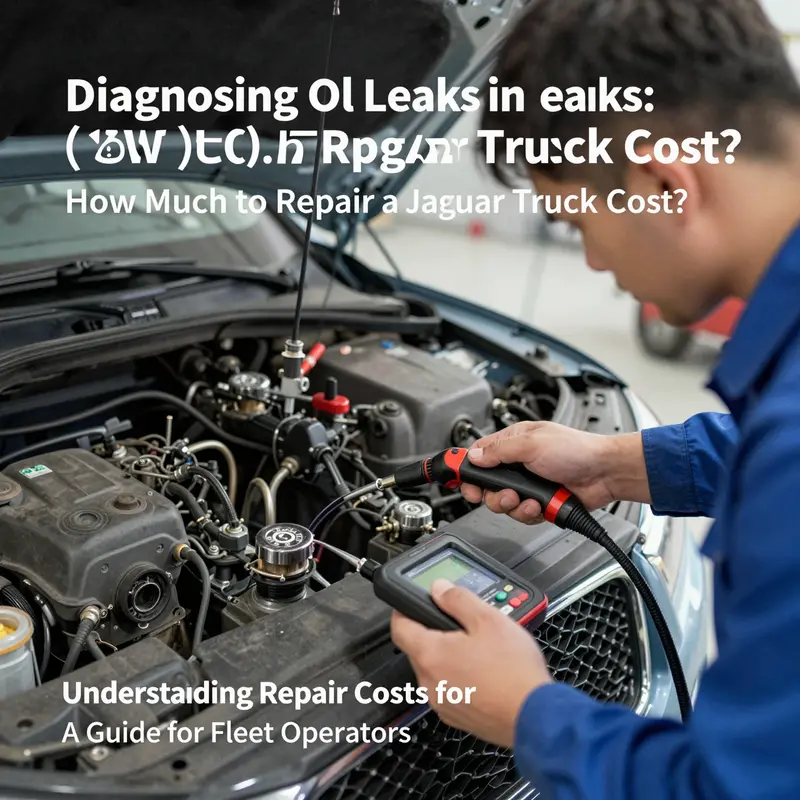
When people ask about repairing a Jaguar truck, the first truth to clear is simple and unavoidable: Jaguar does not make a production truck. The word truck implies a heavy-duty, commercial workhorse, a category that sits outside the British luxury brand’s lineup, which focuses on sedans, coupes, and premium SUVs. Yet the confusion is understandable. The price tag people worry about in a story about a Jaguar is not about a commercial chassis, but about the engine you find beneath the hood of a modern Jaguar model. And within that world, the most common surprise customers encounter is not a spectacular drivetrain failure, but a stubborn engine oil leak that can balloon into a far bigger bill if misdiagnosed. The real task, then, is to translate the language of oil leaks into a practical understanding of cost, so you can separate a minor fix from a misdiagnosed catastrophe and avoid paying for work you don’t actually need.
A practical starting point is to recognize that for many recent Jaguar and Land Rover vehicles, the engine in question belongs to the Ingenium family, the 2.0-liter turbocharged inline-four that powers a surprising number of models. This engine’s design is elegant and efficient, but it has a known quirk that can show up as an oil leak. The most frequently cited issue is a small rubber plug located at the back of the engine that can degrade over time. When this plug fails, a leak can appear, often misinterpreted by a shop as a symptom of a more dramatic seal problem. The cost to address this particular plug—replacing the plug and resealing the area with a careful eye on the surrounding components—tends to sit in a relatively approachable range: roughly $150 to $300, including labor. It is a stubborn reminder that in complex engines, many leaks are not dramatic failures at all, but small, solvable maintenance items that require a trained eye to identify accurately.
The danger of misdiagnosis is not theoretical. If a technician rushes to a grand replacement, the bill can escalate quickly. In the worst-case storytelling you sometimes hear, a leak is diagnosed as a crankshaft rear seal, or a transmission front seal, and the shop quotes a repair that involves removing major assemblies. Those expensive scenarios can mount into the thousands—often cited between $1,500 and $4,000, and sometimes higher when additional components are involved. If a leak is wrongly attributed to a seal that remains in good condition, the customer ends up paying for a job that would never have restored a simple plug leak. The reality, supported by credible service notes, is that the small plug replacement is a much more common, cost-effective fix than the dramatic repairs that technicians sometimes propose when they haven’t ruled out simpler sources first.
Beyond the plug, several other sources can contribute to oil leaks on Jaguar engines. The engine seals themselves wear with mileage: the valve cover gaskets can seep; the oil pan gasket and the rear main seal can degrade; and hoses and fittings around the oil cooler or turbocharger lines are also susceptible to slow seepage. It is easy to sound alarm bells over these components because any oil leak can trigger the oil level warning and create a trail beneath the car. Yet many of these issues can be addressed without the heavy labor of tearing down the engine, especially if the leak is detected early. When a broader leak is confirmed, the costs can escalate, but they are still generally predictable within the framework of the repair family: the cost of the part plus the labor required to replace it.
To give a sense of the scale, consider a typical diagnostic path. A preliminary evaluation at an authorized service center usually costs about $100 to $200. The technician will perform an exterior inspection and then use a fluorescing agent to illuminate the exact source of the leak. This step is crucial because it may reveal that a visible oil stain is simply staining from a small, easily accessible gasket rather than from a high-stakes seal area that demands engine removal. The diagnostic phase, though not glamorous, saves owners from stepping into a larger repair program that isn’t needed. The key message here is not urgency but accuracy: a careful diagnosis sets the stage for a repair plan that reflects the real root cause rather than a worst-case scenario.
When it comes to actual repairs, the cost landscape can be summarized in a few practical ranges. Replacing the valve cover gasket or the oil pan gasket typically involves a few hours of labor and modest to moderate parts costs, often landing in the vicinity of $600 to $1,500 depending on the exact model, the part quality, and regional labor rates. Replacing crankshaft oil seals—if that becomes the necessary remedy—usually commands a higher cost, around $1,200 to $2,000, as the work involves more disassembly and careful reassembly to preserve engine timing and lubrication integrity. If the leak originates from the turbocharger assembly or related lines—an issue particular to turbocharged Ingenium engines—this can push costs higher still, with total repair bills sometimes entering the $3,000 to $5,000 range or more for a full turbo replacement.
Another angle to consider is concurrent maintenance. If the leak exposes other aging systems that are near the end of their lifespans, owners might find themselves addressing several issues in one visit. Worn coolant hoses, degraded thermostat units, a slipping or failing timing belt, or worn engine mounts can all accompany an oil leak and together raise the bill. In scenarios where multiple systems are repaired in one plan, a reasonable total could land in the $800 to $2,000 range for a bundle of complementary fixes alongside the oil leak repair. The important takeaway is that the reference cost of an oil leak repair is highly sensitive to the leak’s location and the vehicle’s overall condition—and the need to address related systems to ensure long-term reliability cannot be overlooked.
From a consumer’s perspective, the most prudent approach is to treat the repair journey as a curated sequence rather than a single leap. Start with the diagnosis, insist on a Jaguar specialist or a shop with solid experience in Ingenium engines, and request a written diagnosis that clearly identifies the leak’s source. This documentation helps avoid the temptation to approve expensive repairs that do not address the actual leak. If the diagnosis points to the simple back-of-engine plug, you have a reasonable expectation that a repair will stay near the lower end of the cost spectrum. If, however, a seal or a more complex component is identified, you should receive a detailed breakdown that explains why the higher-cost repair is necessary and how the shop intends to ensure the fix will endure.
In navigating these costs, an important distinction remains: there is no Jaguar truck, and therefore no separate price tag for a truck repair. The costs described here apply to Jaguar automobiles and their engines. For someone budgeting for Jaguar maintenance more broadly, it helps to adopt a proactive stance toward oil-leak prevention. Early detection, regular maintenance, and using qualified technicians who understand Ingenium engines reduce both the probability of dramatic failures and the likelihood of counterproductive misdiagnoses. A small investment in diagnostics can prevent a large, unwarranted bill later on.
For readers who want a practical touchstone, consider budgeting for routine maintenance with a plan that accommodates occasional diagnostic checks and potential seal work. The budgeting mindset is especially valuable for owners who are approaching higher mileage where leaks become more common. It is useful to frame maintenance as a spectrum—from everyday oil changes and filter replacements to targeted leak repairs—so you can anticipate costs without abandoning the car for Saturdays in the shop. This approach aligns with a broader strategy: treating the Jaguar as a precision instrument whose health benefits from careful stewardship rather than reactive, high-cost fixes.
In closing, the dealer or independent shop can guide you through the cost expectations for Ingenium engine oil leaks, but the numbers you’ll actually pay hinge on the leak’s true source and any concurrent issues. The most affordable fix is the one correctly identified early—the back-of-engine plug that sometimes masquerades as a larger problem. Always seek a second opinion if a diagnosis seems to push toward major overhauls without first confirming the plug-leak scenario. And when you discuss the repair with a shop, use clear, model-specific language so you don’t end up paying for a repair you don’t need. If you’re open to a grounded, diagnostic-first approach, you’ll walk away with a fair repair bill and a Jaguar that keeps running smoothly for miles to come.
For readers planning maintenance budgets, a quick reference is to reserve funds for a diagnostic visit plus the potential for minor gasket work in the low-to-mid range, and to understand that more extensive seal repairs or turbo-related fixes can lift costs substantially. If you want a practical starting point for budgeting in your own vehicle-maintenance plan, explore budgeting resources designed specifically for routine truck maintenance and apply the same discipline to your Jaguar upkeep. Budgeting for Routine Truck Maintenance offers a framework you can adapt to a luxury car context, ensuring you’re prepared without overcommitting to a single repair episode.
For authoritative guidance and service documentation on Ingenium engines, the official Jaguar Land Rover technical support portal remains the best external reference to understand service bulletins, official procedures, and dealer recommendations. See the official technical support portal for the most up-to-date, model-specific information on engine oil leaks and the recommended repair paths.
null

null
Final thoughts
Understanding the costs associated with repairing Jaguar vehicles is crucial for fleet managers and operators in various industries. From recognizing common engine issues to evaluating labor costs, and implementing preventative maintenance, every aspect plays a significant role in effective fleet management. By being informed and proactive, you can significantly reduce unexpected repair costs, ensuring your operations run smoothly and economically.