
Navigating the complexities of commercial truck repair demands a skilled hand backed by experience. In today’s rapidly evolving trucking industry, where advanced electronic systems govern performance, the precision and intuition of seasoned technicians can significantly influence operational efficiency and fleet longevity. This exploration serves to highlight six critical areas where experience plays a pivotal role: from diagnostic precision to the ability to troubleshoot complex issues, and from understanding vehicle systems to preventing future failures. Each chapter delves into how these aspects collectively ensure that repairs are not only effective but also strategically enhance your fleet’s productivity and reduce downtime.
Reading Between the Codes: How Experience Delivers Diagnostic Precision in Commercial Truck Repair
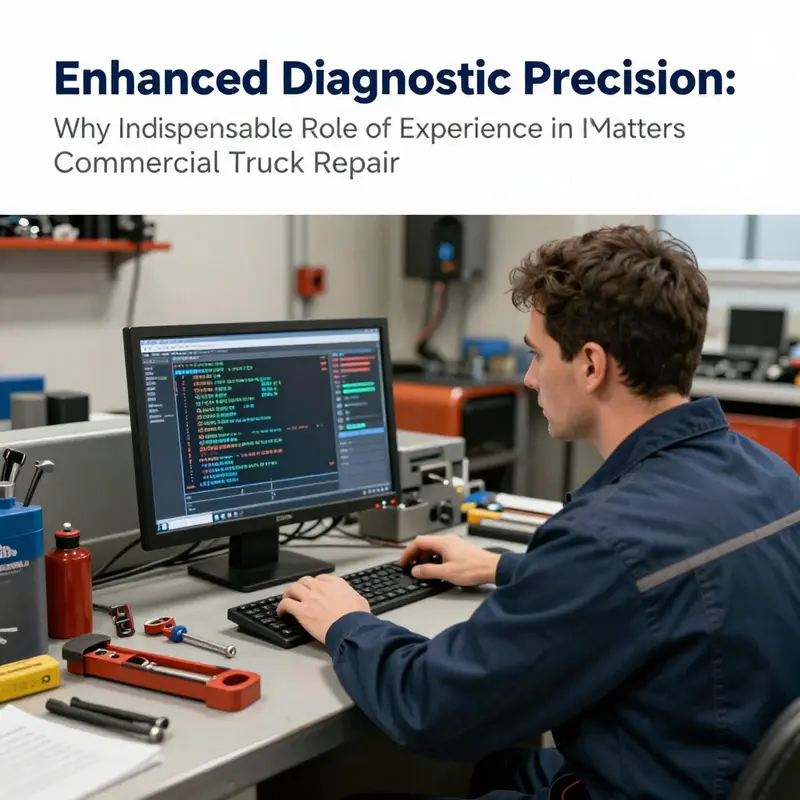
Accurate diagnostics in commercial truck repair begins where raw data ends. Modern trucks deliver streams of information. Sensors report pressures, temperatures, voltages, and engine events. Electronic control units flag fault codes. On their own, these outputs form a flat report. Experience gives that data depth, connecting dots and revealing the true cause behind an alert.
An experienced technician treats diagnostic trouble codes as starting points, not final answers. A DTC often identifies a symptom. It does not always name the root cause. Years in the shop teach technicians which symptoms commonly mask other failures. For example, fluctuating fuel pressure can suggest a failing pump. It can also stem from a small air leak, contaminated fuel, or an intermittent wiring fault. A seasoned mechanic narrows options quickly. They combine live-scan patterns with hands-on checks. They listen, feel, and visualize how parts behave under load. That skill prevents needless parts changes and long repeat repairs.
Experience builds a practical mental library of symptom clusters. When certain noises, readings, and driving histories appear together, an experienced mind recognizes the pattern. Trucks driven on steep routes with heavy loads show different wear than those in stop-and-go urban service. Temperature swings and altitude shifts change air density and fluid behavior. An experienced technician interprets those contextual clues. They see how a slight misfire at high altitude has different implications than one at sea level. They understand how a transmission hesitation after a long downhill run likely ties to heat soak or fluid aeration, not always a control module fault.
This contextual reading matters for uptime. Fleet operators measure success in hours on the road. A methodical technician who eliminates unlikely causes fast reduces diagnostic time. That efficiency cuts downtime and lowers costs. In practice, experienced diagnostics translate to fewer failed repairs, faster turnarounds, and better use of parts inventory. Fleets that prioritize experienced staff often report lower repeat repair rates and higher vehicle availability. Those outcomes come from a technician’s ability to separate transient faults from true failures.
Experience also refines the use of diagnostic tools. Scanners, oscilloscopes, and OEM software are powerful. But they can produce misleading signals without the right interpretation. A novice may treat an occasional spike as a component death warrant. A veteran knows to reproduce the symptom, to probe upstream and downstream signals, and to watch for intermittent behavior. They know when to trust a logged event and when to recreate conditions on a test rig. That judgment preserves parts and avoids cascading, unnecessary repairs.
Beyond electronics, experience sharpens attention to subtle mechanical cues. Slight changes in vibration, an unusual exhaust note, or a particular smell often precede a code. Those cues are rarely captured by software. A technician who has heard that exact pitch from a failing turbo or felt that unique shudder from a fatigue crack will catch the fault earlier. Early detection limits collateral damage. It stops a minor bearing issue from progressing to a seized assembly that demands a full replacement.
Experience also improves troubleshooting under constraints. Trucks break down in unforgiving conditions. A remote job may lack ideal tools or replacement parts. In those moments, technicians must improvise safe, effective interim repairs. A skilled mechanic knows which temporary fixes preserve function until proper service is possible. They can prioritize fixes that preserve safety and protect critical systems. That judgment helps fleets continue operations without exposing drivers to unnecessary risk.
Predictive maintenance and advanced monitoring systems are valuable additions. They flag trends and predict failures. However, those systems still require interpretation. Experienced technicians read trend charts with skepticism and insight. They know which deviations are meaningful and which are noise. They weigh historical vehicle behavior against current anomalies. This human layer increases the accuracy of predictive programs and improves maintenance scheduling.
The long-term value of diagnostic experience shows in lifecycle planning. A technician who understands why a component fails recommends changes that prevent recurrence. That advice covers maintenance intervals, correct fluid specifications, and useful upgrades. It also covers operational changes. Adjusting cooling strategies, shifting load distributions, or altering routing can reduce stress on specific components. These recommendations lower fleet-wide failure rates and extend asset life.
Communication is another area where experience pays. Technicians must translate technical findings into clear guidance for fleet managers and drivers. An experienced technician explains urgency, outlines options, and ties repairs to operating costs. That clarity helps managers prioritize work and align budgets. It also enables smarter stocking of spare parts and better decisions about when to replace rather than repair.
Experience is cultivated through decades of repairs and through mentorship. Senior technicians pass practical shortcuts, diagnostic heuristics, and cautionary lessons to newer staff. That transfer of tacit knowledge multiplies the value of diagnostic tools across the shop. Investing in experienced personnel and focused training yields measurable returns through fewer repeat repairs and improved fleet uptime. For fleets weighing maintenance budgets, this approach often proves more cost-effective than relying solely on scheduled or automated services. For guidance on planning maintenance budgets that reflect these realities, see the resource on budgeting for routine truck maintenance.
Finally, precision in diagnostics preserves safety. Misdiagnosing braking or steering faults can have severe consequences. Experience reduces the risk of human error in those critical repairs. Seasoned technicians confirm diagnostics with multiple checks, cross-reference systems, and verify repairs under realistic loads. That discipline keeps vehicles safe on the road and protects drivers and cargo.
Technology will continue to improve and provide ever more data. Yet the core task remains the same: convert data into correct action. Experience is the bridge between signal and solution. It filters noise, identifies root causes, and ensures repairs address the real problem. For commercial fleets, that difference is not academic. It shows plainly in fewer breakdowns, lower lifetime repair costs, and safer operations.
External reference: https://www.truckequipment.com/article/why-experience-matters-in-truck-repair
Internal resource: budgeting for routine truck maintenance
System Savvy: How Deep Familiarity with Truck Systems Turns Experience into Reliable Repairs
System Savvy: How Deep Familiarity with Truck Systems Turns Experience into Reliable Repairs
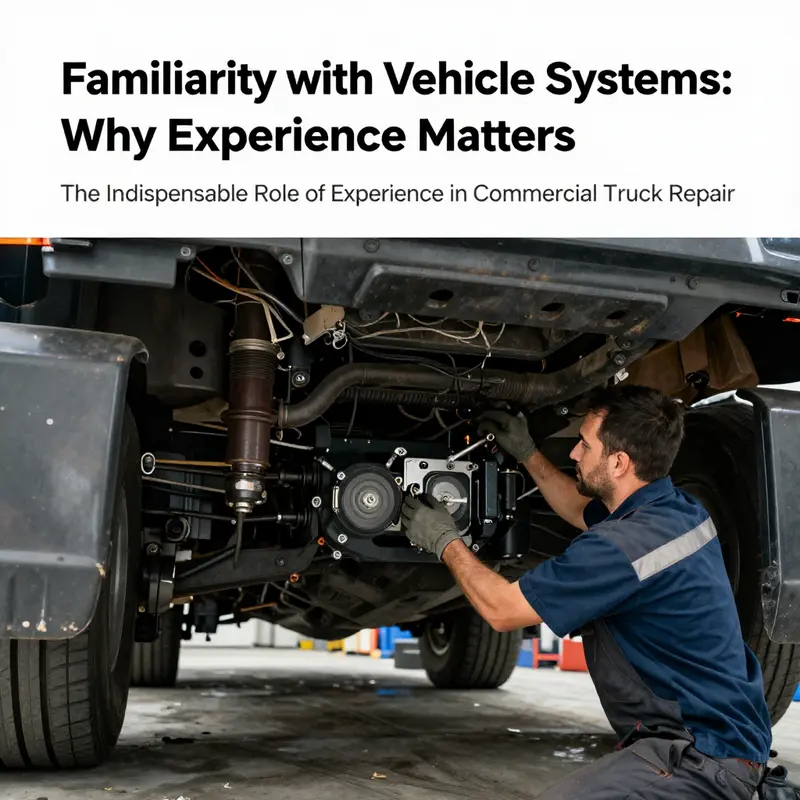
In commercial truck repair, familiarity with vehicle systems is the crucible where knowledge becomes practical skill. Modern trucks are assemblies of mechanical, hydraulic, and electronic subsystems that interact in subtle, often non-obvious ways. An experienced technician treats those interactions like a language. They read patterns rather than isolated symptoms. That reading skill is what separates a fast, correct repair from repeated breakdowns and wasted labor.
Experience builds a mental map of how systems behave under varied conditions. A technician with thousands of hours working on engines, transmissions, brakes, and after-treatment systems can anticipate how one fault will ripple through other subsystems. For example, an exhaust restriction might trigger engine derate, raise temperatures, and change fuel trim. A novice might chase each alarm separately. The seasoned technician sees the common thread immediately and tests the likely root cause first. This reduces diagnostic time and avoids unnecessary replacements.
Electronics and computer diagnostics have changed shop workflows, but they have not replaced the need for deep system knowledge. Diagnostic trouble codes (DTCs) are pointers, not answers. Experience teaches context. A code that appears after a hard run could be a transient sensor reading. The same code during steady-state cruise could point to a failing component. Technicians who have seen similar patterns will know which sensors to verify and which wiring or harness locations to inspect. Their intuition, born from repetition, lets them separate false positives from real faults quickly.
Subtle physical cues are another area where familiarity pays off. A slight harmonic in a driveline, a barely perceptible change in pedal feel, or a dashboard light that flickers in a pattern are signs a trained eye and ear recognize. These cues often precede overt failure by days or weeks. When a mechanic recognizes them, they can prescribe targeted interventions—tightening a mount, reconditioning a bearing, or recalibrating a sensor—before a roadside failure occurs. That preventative action keeps trucks on the road and reduces costly emergency repairs.
Practical experience also refines testing procedures. Nearly every system in a heavy truck has recommended diagnostic steps. An experienced technician knows which steps to follow and when to deviate. They choose the correct test equipment, set up conditions for a meaningful readout, and interpret the results with an awareness of real-world variables. For example, they understand how altitude, load, or ambient temperature affects sensor outputs and adjust their expectations accordingly. This reduces false diagnoses that arise from applying bench values to field conditions.
The mental database of past repairs is a powerful tool. Technicians accumulate a catalogue of failure modes and workarounds. When a problem recurs, that catalogue shortens the path to resolution. It also helps when parts are backordered or unavailable. Experienced technicians can design temporary, safe fixes that allow a truck to complete its route without risking greater damage. Those decisions balance immediate operational needs with long-term vehicle health, and they come from a pragmatic understanding of system behavior.
Another important dimension is maintenance evolution. Components once serviced with routine greasing or frequent adjustments are increasingly sealed or specified as long-life. Experience allows technicians to recognize when older maintenance habits no longer apply. They adapt by learning new service intervals, using updated fluids, and following manufacturer calibration procedures. The best shops combine on-the-job wisdom with current technical bulletins and service manuals to avoid both over-servicing and neglect.
System integration tasks, such as sensor calibrations or after-treatment regeneration, require both procedural knowledge and tactile skill. Calibrating a sensor is one thing; knowing how its reading will affect downstream control logic is another. Experience helps technicians calibrate in ways that align with fleet operation realities. That might mean choosing a calibration strategy that reduces nuisance regenerations or setting parameters to improve drivability while staying within emissions rules. Those nuanced choices preserve uptime and comply with regulations.
Experience also builds effective communication with drivers and fleet managers. Technicians who have seen common failure stories can ask precise questions and interpret driver descriptions accurately. A driver complaint about “loss of power uphill” has different diagnostic priorities than one about “stalling at idle.” The experienced technician extracts the right information and links it to probable system failures. That skill shortens the diagnostic loop and helps prioritize repairs that restore revenue-generating operation fastest.
For fleets managing in-house maintenance, institutionalizing experienced-based practices improves reliability across the board. Shops that pair formal training with mentorship programs capture tacit knowledge and pass it on to junior staff. They document recurring failure modes and standardize repair responses. That institutional memory reduces variability and aligns decisions with long-term fleet goals. For a practical example of in-house maintenance best practices, see Turnage Sons in-house truck maintenance.
Finally, experience fosters foresight. A veteran technician does not stop at the immediate fix. They assess adjacent components for wear, advise on preventative replacements, and recommend adjustments to maintenance intervals based on real-world data. This forward-looking approach prevents repeated failures and extends component life. For fleet operators, the result is fewer breakdowns, lower total cost of ownership, and higher vehicle availability.
Experience matters because modern truck repair is as much about systems thinking as it is about parts swapping. Technicians who deeply understand how systems integrate and how they fail save time and money. They bring judgment to ambiguous diagnostics and resilience to unpredictable field conditions. Their work reduces downtime, prevents repeat visits, and protects the fleet’s bottom line.
For ongoing insights and community-shared experience, industry forums remain valuable resources. One such resource that consistently aggregates frontline insights and practical advice is TruckersReport: https://www.truckersreport.com/.
From Codes to Confidence: How Experience Drives Efficient Truck Repairs
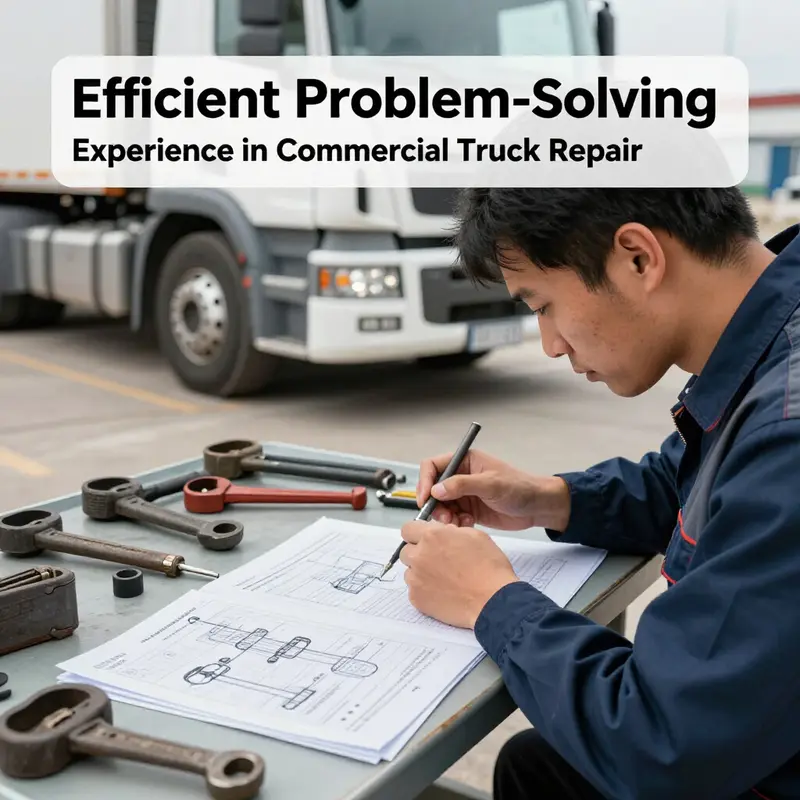
Experience in commercial truck repair is not merely a résumé bullet. It is the practical engine behind every efficient diagnosis, every reliable fix, and every hour of uptime that keeps a fleet moving. The transition from a rule-based approach to a results-driven one happens when a technician stops treating a diagnostic trouble code as a single culprit and starts reading the broader story the truck is telling. As one veteran mechanic likes to remind newcomers, the machine often speaks in a language that blends data with memory: “The machine tells you what’s wrong; only experience tells you why it happened—and how to prevent it next time.” That sentiment captures a core truth in modern fleets: experience converts raw data into actionable insight, compressing what might otherwise be hours of trial-and-error into a careful, repeatable sequence of checks and decisions. This is especially vital when the technology inside heavy-duty trucks has grown ever more complex, tying together engines, exhaust after-treatment, and electronic controls in ways that challenge traditional wrench work alone.
Today’s heavy trucks rely on electronic control units, sensors, and feedback loops that demand not only understanding of theory but also the hands-on cadence of seasoned repair work. The case of advanced engine platforms—such as those with tightly integrated fuel, air, and exhaust management—illustrates how a well-practiced technician uses diagnostic data as a map, not a verdict. They interpret data in context, cross-referencing readings with the vehicle’s behavior under load, ambient conditions, and recent maintenance history. When a fault code lights up, an experienced eye asks the right questions: Is this a genuine fault, or a symptom of a larger ecosystem issue? Could a bad sensor be feeding a chain reaction? Is a recurring pattern pointing to a design weakness or an installation variable that wore on a component differently in the field? The answers often hinge on subtle cues—slight shifts in engine timing feel, a barely perceptible vibration, or a warning-light sequence that aligns with a specific operating condition.
The modern diagnostic landscape cannot be mastered by manuals alone. A 2020 industry reflection highlighted how quickly truck technology has evolved beyond the comfort zone of many first-generation mechanics. Yet experience bridges that gap by offering a mental file cabinet loaded with prior contexts. When a technician has seen similar engine control faults across multiple makes and models, they know which diagnostic routes are worth pursuing and which are red herrings. This is not about guessing; it is about leveraging a history of outcomes to prune the search space. The result is not merely faster repairs but more reliable ones. In fleets where downtime translates directly into lost revenue, the value of that cognitive shortcut cannot be overstated.
There is also a strategic dimension to experience. It shapes how a technician prioritizes fixes, allocates scarce parts, and coordinates work under pressure. In practice, an experienced mechanic can routinely distinguish between a quick, low-cost repair and a more involved solution that preserves long-term reliability. They understand the cascade effects of replacements—how replacing a single part might reveal wear patterns in neighboring components, or how a fix in one subsystem can influence another through shared heat, vibration, or electrical load. This depth of understanding matters most when trucks operate in demanding environments. A fleet that runs mountain grades, stop-and-go urban routes, or remote locations faces wear patterns that diverge sharply from highway duty. The ability to predict how these patterns will evolve, rather than simply reacting to the next failure, is a direct outgrowth of experience.
Experience also reframes the meaning of predictive maintenance. Predictive tools collect data on load, altitude, engine temperature, and driving behavior, but their value is realized only when a technician can translate that data into tailored service intervals. A fixed-mileage schedule, as one long-running case study from a regional fleet showed, wastes maintenance resources on over-servicing and leaves critical wear unaddressed in under-serviced situations. The result is a double-edged cost: unnecessary parts and labor tied up in maintenance that does not deliver proportional benefit, paired with the elevated risk of sudden, expensive failures. A more nuanced approach, guided by experienced judgment, reads the real workload of each vehicle. When combined with real-time data, this knowledge enables maintenance to become a dynamic process—one that matches service to actual use rather than to an arbitrary calendar.
The practical upshot of seasoned problem-solving is visible in how repairs are approached in the field. A veteran technician does not simply “fix what’s broken”; they seek the root cause and anticipate where the next failure might arise. This requires more than a good eye; it requires a robust decision framework built on accumulated experience. For example, when addressing a recurring oil-consumption issue on certain heavy-duty engines, an experienced team will probe beyond the surface symptom of burning oil. They look for systemic contributors: engine load profiles that exaggerate wear in piston rings, lubrication system timing that creates unforeseen stress in particular operating regimes, or changes in fuel quality that alter combustion end-products. Each observation informs a broader repair strategy, one that prevents future failures rather than simply addressing the immediate fault.
These capabilities come alive when the repair environment itself is designed to leverage human expertise. In many fleets, the combination of skilled technicians and predictive maintenance systems yields the most durable outcomes. Real-world data enriches the technician’s intuition, turning abstract trends into concrete action—such as deciding when to replace a component proactively, or when to redesign an operating procedure to reduce vibration-induced wear. The synergy of human judgment and machine-assisted insight translates into rapid fault isolation, smarter part selection, and repairs that last longer under the vehicle’s real-world load. In this sense, experience is not a counterpoint to technology; it is the missing link that makes technology actionable.
For fleet operators seeking practical examples of how experience translates into value, consider the broader maintenance ecosystem in which repairs occur. Efficient problem-solving does not rely on high-cost diagnostic towers or blindly replacing parts. It rests on the technician’s ability to test hypotheses quickly, sequence repairs in the most economical order, and communicate risks and timelines clearly to managers. The most effective technicians build a narrative around a fault—thewhy behind the what—and they use that narrative to guide preventative strategies. When a truck returns to the road after a repair, the operational team benefits from the confidence that the fix was grounded in solid engineering judgment, not just a code-clearing reset.
It is in this context that a simple but powerful principle emerges: experience reduces downtime, and downtime is the enemy of profitability. The value of skilled troubleshooting becomes especially pronounced as trucks incorporate ever more sophisticated electronic systems. The complexity of control logic, sensor feedback, and after-treatment management means that a misinterpretation of data can lead a fleet down a costly detour. An experienced technician reduces that risk by recognizing when a fault code is likely a symptom rather than a cause, when a sensor reading is tampered by external factors, or when a software fault masks a hardware issue. They anticipate failures based on patterns learned from countless prior jobs, and they select repairs that strengthen the vehicle’s resilience against future stress.
In this light, the integration of hands-on expertise with disciplined maintenance planning yields a practical, repeatable framework for efficient repair. Fleets that invest in experienced technicians and foster continuous learning—while also embracing predictive maintenance tools—tend to outperform those that rely on generic protocols alone. The conversation between code and context—between data and experience—becomes the heartbeat of modern heavy-truck repair. When management understands that experience shortens diagnostic cycles and improves repair quality, they recognize that investing in skill development is not a luxury but a core maintenance strategy. This is why experience matters: it is the human element that converts measurement into reliability, and reliability into sustainable profitability for commercial trucking operations.
For readers exploring how to translate this knowledge into action, one practical step is to look at internal maintenance practices that empower skilled technicians to apply experience more effectively. Some fleets lean into in-house truck maintenance programs, such as those highlighted in Turnage-Sons-In-House-Truck-Maintenance, to build continuity between repair work and fleet operations. Linking hands-on repair rigor with a structured maintenance cadence ensures that lessons learned on the shop floor inform future service decisions, creating a feedback loop that continually improves reliability and uptime. This approach reinforces the central claim of this chapter: experience is the decisive driver of efficient problem-solving in commercial truck repair, aligning diagnostic precision with durable, cost-effective maintenance outcomes.
For readers seeking further scholarly context and industry-facing analysis, the field is increasingly integrating predictive maintenance with real-world operation data. A 2026 study from the China Automotive Engineering Society highlights the challenges and solutions of predictive maintenance in heavy-duty trucks, underscoring how real-time workload data can tailor service intervals and reduce unnecessary servicing while preventing major failures. The study reinforces the point that technology amplifies, rather than replaces, the technician’s expertise. See the external resource for deeper exploration of predictive maintenance dynamics and implementation considerations.
External resource for further reading: https://www.caes.org.cn/zh-CN/Research/Reports/2026/HeavyTruckMaintenanceReport.pdf
Reading the Road Ahead: How Experience Guides Complex Truck Repairs in a Data-Driven Era

In the world of commercial trucking, the road rarely presents a straightforward maintenance problem. It often throws together a constellation of symptoms—fuel, fuel delivery, suspension wear, electronic control signals, and shifting dynamics under load—that must be understood as a single, interacting system. This is where experience ceases to be a nice-to-have and becomes the centerpiece of effective repair work. An experienced technician does more than read diagnostic trouble codes; they translate those codes into a broader reading of the machine’s behavior. They know which signals are hints and which are alarms, which noises merit immediate action and which patterns simply reflect normal traffic of wear and aging. In practice, seasoned hands cultivate a kind of professional instinct: they hear a change in a note from the engine, feel a barely perceptible vibration through the pedal, and recognize that these may be early signs of a deeper mismatch among systems. That intuition is not magical; it is the distilled memory of countless miles, climates, and job conditions that shape a repair in real time, long before a manual or an online forum could offer a reliable answer.
When a heavy-duty truck operates in challenging environments, experience matters even more. Picture a vehicle constantly hauling heavy loads through mountainous terrain. The Wumeng Mountains, with their dramatic elevation changes, variable temperatures, and sustained engine loads, present a testing ground for both the machine and the techs who service it. An entrant to the field might rely on a standard service interval, say 30,000 kilometers, as if all routes and elevations were alike. An experienced technician, however, reads the road differently. They understand that sustained climbs and engine lugging accelerate wear in ways that a flat-road schedule cannot anticipate. They look at an oil sample, not merely for metal particles or viscosity, but for the nuanced story it tells when fuel dilution or unusual wear traces appear alongside normal baseline readings. In this way, experience converts a routine maintenance plan into a dynamic judgment about when to service, what to inspect, and how aggressively to pursue a repair that might otherwise be postponed.
Another facet of expertise emerges in the ability to interpret real-time vehicle data within its full operating context. Modern trucks carry a torrent of data from multiple subsystems: engine management, transmission shift patterns, brake-by-wire or traditional braking signals, suspension responses, and a web of sensors governing after-treatment systems. An experienced technician does not treat these data streams as isolated facts; they stitch them into a narrative of how the truck behaves under varying workloads. If a sensor reports a borderline reading, the seasoned pro asks questions a less experienced mechanic might not consider: Is the vehicle carrying a heavier load than usual? Has ambient temperature shifted enough to alter sensor behavior? Could a fluke in a single sensor be echoing a deeper issue with a related component? The ability to interpret this kind of context turns raw data into actionable steps that prevent unnecessary downtime and avert cascading failures.
Predictive maintenance has become a focal point for fleets trying to balance reliability with uptime. Yet predictive maintenance is most effective when guided by experience. A rigid, one-size-fits-all approach—still adopted by a sizeable share of fleets—can lead to premature replacements or missed warning signs. Industry insights from a leading vehicle technology research program spanning 2023 to 2025 underscore a shift toward condition-based servicing. These findings emphasize that real-time telematics data must be interpreted in light of operational realities: load profiles, driving behavior, ambient temperature, and engine cycle history all influence wear rates and component life. A technician with field intuition can translate this data into precise maintenance actions, tailoring service windows to the actual demand placed on each vehicle. The shift toward predictive maintenance is less about replacing human judgment with an algorithm and more about empowering the technician’s judgment with better, more contextual information. It is the blend of data and experience that yields timing and interventions that minimize downtime while maximizing efficiency.
Experience also plays a crucial role in handling the unpredictable. Trucks are intended to move goods, but they do so in environments where parts may be scarce, weather can turn foul, and a repair may need to proceed under less-than-ideal conditions. In such moments, the veteran technician excels at risk assessment, improvisation, and prioritization. They know when to pursue a conservative fix and when a more extensive repair is warranted to avoid a recurring problem. They understand how to secure a challenging repair in a remote location, how to sequence tasks to reduce further risk, and how to communicate the trade-offs to fleet managers who must weigh cost against downtime. This kind of decision-making is not simply a matter of technical skill; it is a discipline formed through years of steering through the gray areas where manuals stop and experience begins.
The practical benefits of this expertise extend beyond immediate repair outcomes. A seasoned technician does not stop at “the fix.” They anticipate future weak points or signs of wear that could become disruptive later. They recommend preventative maintenance or strategic upgrades that extend a vehicle’s life and lower the likelihood of unplanned outages. In other words, experience translates into long-term fleet health. While a modern diagnostic system provides the surface-level diagnosis and confirms potential issues, it is the experienced practitioner who tests the validity of those findings against the truck’s history, its typical duty cycle, and the operator’s feedback. They ask: Is this symptom a one-off or a symptom of a creeping pattern? Is this repair likely to hold up under uphill hauling during peak season, or will it require rework soon after the road returns to its flatter, less demanding sections? Those questions, resiliently answered by the veteran, are what convert a repair into a durable, reliable fix.
A broader strategic consequence follows. As the industry moves toward smarter, more connected operations, the role of the experienced technician becomes not a gatekeeper of knowledge but a translator of data into reliable, actionable plans. They bridge the gap between theory and practice—between the theoretical models that describe how a system should behave and the messy, real-world conditions in which it actually operates. In the field, this bridge is essential for safety, reliability, and profitability. Safe, dependable trucks prevent accidents, reduce warranty and downtime costs, and keep fleets on schedule. Profitable operations depend on minimizing unplanned downtime, and only an experienced hand can consistently translate sensor chatter into targeted, effective maintenance that keeps vehicles moving without unnecessary delays.
For those who manage fleets, the lesson is not to devalue technology, but to recognize where human judgment remains indispensable. A technician’s experiential insight elevates data-driven insights from information to wisdom. The most advanced diagnostic systems can point to a fault, but the experienced technician understands the broader implications of that fault: how it affects uptime, how it correlates with driver behavior, how it interacts with a vehicle’s variables as it climbs grades or descends into heat, and how best to prevent recurrence. In the evolving landscape of fleet maintenance, experience supports the science of predictive maintenance with the art of prudent decision-making. If fleets want to future-proof operations, they must not only invest in sensors and connectivity but also in the skilled technicians who can interpret what those signals mean in the field.
Those who are shaping maintenance strategies today are increasingly aware that experience still determines the quality and longevity of repairs. An experienced technician’s ability to interpret multiple, interlocking signals—engine health, transmission behavior, brake response, suspension dynamics, and electronic interactions—means repairs are not only correct but durable. They understand the why behind the what, linking a symptom to its root cause and to a broader pattern of wear. This depth of understanding reduces costly rework and protects the investment fleets make in their equipment. The road ahead for commercial trucking, with its growing complexity and expanding reliance on data, will still bend to the judgment honed by years of hands-on work. Technology can illuminate, but experience makes the path reliable.
For readers seeking practical examples and case-driven discussion of maintenance challenges, the Master Truck Repair blog offers real-world perspectives drawn from the field. A single post can illuminate how technicians interpret a cluster of warning signals and decide on a repair strategy that keeps a fleet moving. Access to such hands-on insights can complement the data-centric tools that increasingly shape maintenance planning. Master Truck Repair blog
Ultimately, experience is the quiet backbone of reliability in commercial truck repair. It makes sense of the data, mitigates risk in unpredictable situations, and turns routine maintenance into a shield against costly, disruptive failures. As fleets adopt more sophisticated predictive maintenance practices, technicians who have learned the road will remain indispensable. They are the ones who translate the pulse of a vehicle’s systems into timely, effective actions, ensuring safety, uptime, and the profitability that keeps the wheels turning. The future of fleet maintenance will be smarter, but it will still need the seasoned hands that understand why a component fails, how it should be repaired, and when a repair should be staged to prevent a broader breakdown. The road may be data-rich, but it is experience that makes the journey successful.
External resource: https://www.clp.org.cn/research/2025/fleet-maintenance-trends
Stopping Tomorrow’s Breakdowns Today: How Experience Prevents Failures in Commercial Truck Repair
Stopping Tomorrow’s Breakdowns Today: How Experience Prevents Failures in Commercial Truck Repair
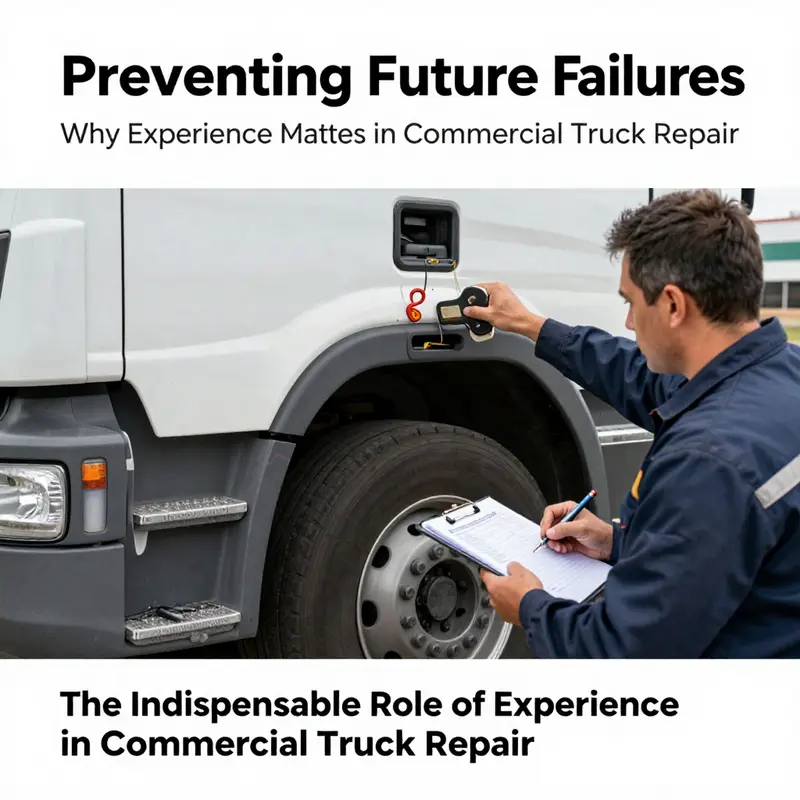
Experience turns inspections into foresight. A technician who has spent years with heavy rigs does more than follow checklists. They read machines the way a seasoned sailor reads weather. That ability to anticipate failure is the single greatest defense against costly, unplanned downtime.
When a truck comes into the bay, a scan tool offers data and a list of trouble codes. Data is useful. Experience gives it context. A veteran technician reads a fault code and asks whether the code is a transient event, a sensor reporting a downstream symptom, or the tip of a deeper mechanical problem. They know which codes often accompany wiring faults, which ones hide intermittent issues, and which ones demand immediate action. This judgment reduces needless parts swaps and focuses labor where it matters.
Beyond codes, experienced technicians detect the faint signals that precede failure. A slight hum inside a gearbox, an odd high-frequency vibration, or a timing of smoke under heavy load—these are not just noises. They are the machine speaking. Techs with long exposure to engines and drivetrains develop mental signal libraries. They compare current cues against that internal archive and decide whether to repair now or monitor. That choice, made early, converts a future catastrophe into a scheduled service.
Preventing failure also demands an eye for patterns. An isolated failure can be a fluke. When several trucks in a fleet show the same subtle wear, a pattern appears. Experienced hands notice patterns quickly. They link a recurring bearing noise to a specific axle load or a repeated injector fault to fuel quality. Identifying these correlations allows targeted interventions that remove the root cause, not just its symptoms.
Practical experience changes how technicians plan repairs. Rather than replacing a single component, a seasoned technician often evaluates related parts for concurrent wear. They recommend replacing neighboring seals, bearings, or hoses when those items are likely to fail soon. That slightly larger upfront cost prevents a second shop visit. For fleet managers, this approach saves both hours and operating revenue.
Experience also informs maintenance schedules. A rigid calendar of services misses real-world variables: operating regions, payloads, duty cycles, and driver habits. Skilled technicians incorporate these variables into service plans. They may tighten intervals for trucks running heavy highway miles with high loads, or extend intervals safely for low-stress yard trucks with light duty. This calibration keeps trucks reliable while avoiding unnecessary work.
A critical, often overlooked skill is trend analysis. Experienced shops track repair and inspection data across time. They watch for rising frequencies of certain faults or slowly worsening parameters. A steadily climbing coolant temperature under the same load profile indicates gradual occlusion in the cooling system. Detecting such trends early enables cleaning, flushing, or component refreshment before heat causes head warpage or a blown gasket.
Field repairs create their own risks. Parts might be scarce on route. Conditions can be messy and risky. Experience matters most here. A seasoned mechanic improvises safely and effectively. They pick temporary fixes that protect critical systems until a permanent repair is possible. They choose materials and techniques that maintain system integrity. Those decisions preserve safety and prevent collateral damage that could turn a single failure into a total loss.
Experience also reduces human error. Many repeat failures stem from incorrect assemblies, improper torques, or skipped steps. A practiced technician runs job sequences with muscle memory and checks. They document torque values, fluid levels, and test results. That discipline prevents comeback repairs caused by oversight rather than mechanical weakness.
Training bridges knowledge gaps, but mentorship transfers practical judgment. Junior techs become more predictive when paired with veterans. An apprenticeship accelerates pattern recognition. It shortens the time needed to trust a gut feeling. For fleets, investing in experienced staff who mentor others multiplies the preventive effect across the whole maintenance team.
Modern trucks demand a fusion of electronic diagnostics and hands-on inspection. Experience is the glue between these domains. When an emissions system registers high NOx readings, an experienced technician doesn’t stop at sensor replacement. They trace exhaust flow, inspect after-treatment hardware, and assess fuel and boost control behavior. They evaluate whether software calibration, clogged DPFs, or physical leaks cause the problem. That integrated approach prevents repeated trips to the shop.
The financial impact of preventive insight is tangible. Each avoided breakdown saves towing, roadside repair, lost load revenue, and accelerated component replacement. Experience lowers lifecycle costs by extending component life. It also preserves resale value by keeping service records clean and failures minimal. For operators, that contributes directly to margins and operational predictability.
Safety and compliance are inseparable from prevention. An expert mechanic spots wear that threatens braking or steering long before it fails inspections. They can advise on corrective steps that satisfy regulatory criteria and keep drivers safe. Preventing a brake-line failure or a steering-box seizure avoids accidents and the costly liabilities that follow.
Finally, experience shapes procurement and inventory decisions. Technicians who know failure modes advise which parts to stock. They help managers decide when to invest in upgraded components or improved sealing technologies for trucks operating in abrasive environments. That insight optimizes spares inventory and ensures the right part is available when needed.
Preventing future failures is not a single act. It is a continuous practice of observation, pattern recognition, thoughtful planning, and targeted intervention. Experience makes that practice both efficient and effective. It converts routine inspections into strategic actions that sustain uptime, protect assets, and keep drivers safe. For any fleet focused on reliability and cost control, experienced repair staff are the best investment.
For guidance on structuring maintenance budgets to support proactive work, see this resource on budgeting for routine truck maintenance.
For more technical reference material from a vehicle manufacturer’s technical service, see: https://www.paccar.com/en/support/technical-service
Final thoughts
In summary, the importance of experience in commercial truck repair cannot be overstated. As the industry continues to innovate with advanced technologies, the need for skilled technicians who can bridge theory with practice becomes critical. Experienced mechanics not only make diagnostic processes more precise but also foster an environment of proactive maintenance, ultimately leading to greater reliability and efficiency. Investing in skilled personnel is essential for any fleet manager or enterprise operator looking to optimize performance and minimize costly downtime.