Defining the Intermittent Derate Problem
An intermittent derate cuts engine power, goes away on its own, and usually leaves no fault code behind. The truck pulls hard one minute, then torque falls off and it feels gutless; a restart often brings the power back. Drivers can’t predict the next loss of power, and the shop gets a complaint it can’t reproduce once the truck is parked in the bay.
A constant fault is straightforward, because it is there every time you look. An intermittent derate is the opposite. The truck behaves perfectly the moment it rolls through the shop door, so every test you run comes back normal.
A few things make this kind of fault hard to pin down:
- Condition-dependent triggers. Many derates need a specific load, ambient temperature, or duty cycle before they appear: a long climb at full throttle, a hot day in traffic, a steady highway cruise. Those conditions are nearly impossible to recreate on a stationary dyno.
- No stored code. The software often clears an intermittent derate before the ECM writes a permanent fault, so the technician starts with a blank scan tool and nowhere obvious to begin.
- Heat, vibration, and wiring. A chafed harness, a failing sensor, or a loose connector may only act up once a component reaches full operating temperature or the chassis sees real road vibration.
- Inconsistent driver reports. Descriptions like “sometimes” and “when it’s hot” are hard to turn into a repeatable test, and the account can change from one driver to the next.
- The temptation to swap parts. When the cause stays hidden, the easy move is to replace components and hope. That drains an emergency repair fund and rarely fixes the real problem.
From here the article focuses on the decision that matters most when you’re chasing this kind of fault: dealer or independent shop. It compares diagnostic tooling, technician experience, cost, and turnaround time, then lays out a code-first way to confirm the root cause before anyone starts swapping parts.
How an Engine Derate Is Triggered
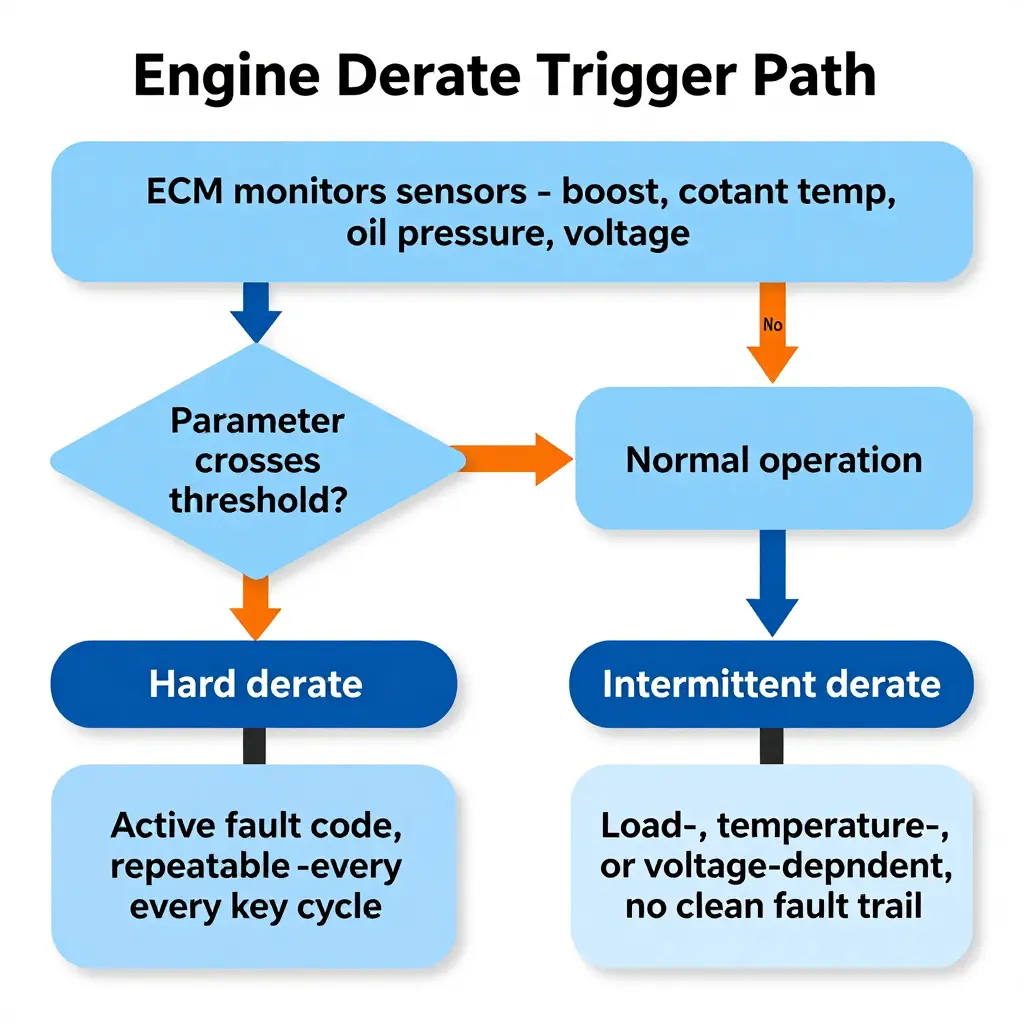
An engine derate is the ECM protecting itself. When a parameter crosses a programmed threshold – boost pressure, coolant temperature, oil pressure, intake air temperature, or a sensor signal – the module limits engine power and road speed to prevent damage. The derate is a symptom, not the failure. The question to answer is what condition pushed the ECM past its limit.
Hard Derates vs. Intermittent Derates
A hard derate is the easy one. It is active, sets a code, and repeats: crank the engine, the same trigger fires, an active fault code is stored, and the truck limps the same way. It reproduces on demand, so the diagnosis path is short.
An intermittent derate only shows up when a specific set of conditions lines up. A load-dependent fault may appear only when the truck pulls a full trailer up a grade. A temperature-dependent derate may trip only after heat soak on a long climb. A voltage-dependent derate may happen only when the batteries or alternator sag under load. These derates often clear themselves the moment the condition passes, so the ECM may never store a clean, repeatable trail.
Why the Fault Keeps Disappearing
The hardware behind an intermittent derate usually behaves perfectly in the shop and badly on the road. A sensor drifts as it heat-soaks or vibrates. A harness chafes against a frame rail and shorts only under a certain twist. A connector corrodes and loses contact when the engine torques under acceleration. An intermittent ground fault can pull a reference voltage low just long enough to trigger a derate, then vanish before anyone catches it.
Because none of these events is constant, the truck often arrives with no active fault code and nothing to reproduce. A technician who chases only the code comes up empty. A technician who understands the trigger condition finds the fault.
What This Looks Like on Real Fleets
The trucks covered on mastertruckrepairllc.com – heavy haulers, fire apparatus, and municipal fleet units – run in exactly the environment that breeds intermittent derates. Fire trucks sit for hours, then run hard on emergency calls; fleet units log stop-and-go miles with constant load changes. That duty cycle exposes heat, vibration, and voltage swings a steady highway truck never sees. It is also why proper fire truck maintenance training pays off: it teaches techs where these triggers actually hide.
The Key Insight
Understanding the trigger condition is the difference between diagnosis and guesswork. Knowing when a derate fires – under load, at temperature, at a voltage dip – tells you where to look. It also frames the decision ahead: whether a dealer or an independent shop is better positioned to catch it before the parts cannon gets loaded.
When you weigh dealer versus independent shop options for an intermittent derate, the question is who can actually diagnose the fault before anyone starts swapping parts.
| Diagnostic Factor | Dealer | Independent Shop |
|---|---|---|
| Access to OEM proprietary diagnostic software | Full, first-party access included with franchise tools | Usually via licensed subscriptions or aftermarket platforms |
| Access to latest service bulletins and reprogramming | Real-time, pushed directly from the OEM | Available through paid portals; sometimes delayed by a few weeks |
| Cost per diagnostic hour | Typically high, plus shop supplies and admin fees | Often 20-40% lower with more flexible billing |
| Wait time / scheduling | Can stretch days or weeks during peak season | Often same-day or next-day, especially for fleets |
| Familiarity with specific platforms | Strong on the makes they sell, weaker on mixed fleets | Typically broad across multiple makes and vintages |
| Ability to perform live data logging | Yes, but sometimes restricted to approved capture routines | Yes, with flexible road-test and extended logging options |
| Flexibility to test non-OEM or aftermarket sensors | Limited; tends to recommend OEM replacement only | High; happy to test, substitute, and compare parts |
| Warranty and liability handling | Structured OEM warranty process and documentation | Shop-backed warranty; varies by provider |
The capability gap between dealers and independents is often smaller than owners expect. Many independent shops now run OEM-grade software, log live data, and reprogram modules in-house, so the deciding factor is usually scheduling and workflow rather than raw diagnostic power.
Why Swapping Parts First Is the Most Expensive Mistake in Derate Diagnosis
When a truck rolls in with an intermittent derate, the instinct is to reach straight for the toolbox. A technician suspects a sensor, swaps it, and waits to see whether the fault returns. This “parts cannon” approach feels productive, but it turns a solvable diagnostic problem into an expensive guessing game, and the customer pays for it.
The Parts Cannon: Speed That Quietly Multiplies Cost
The parts cannon runs on a tempting logic: throw enough components at a fault and one will eventually stick. On a hard, repeatable failure that might stumble into a fix. An intermittent derate won’t cooperate on command. Every unnecessary swap stacks parts, labor, and downtime on a problem that a disciplined budgeting for routine truck maintenance mindset would never have created.
The math gets ugly once you total it. Each guessed component adds a part cost, a labor charge, and another day the truck sits idle, so a two-hour diagnosis becomes a week-long parts bill. That kind of runaway expense is what turns building an emergency repair fund from a safety net into damage control. Shops that protect their margins diagnose before they spend.
How Part Swapping Masks or Relocates the Real Fault
The real cost is this: swapping parts can hide the original fault or move it somewhere new. Replace a sensor and clear the code, and the intermittent derate may vanish just long enough to look solved, then resurface after the truck leaves the bay. A new but incorrect component can also introduce a second fault that competes with the first, leaving the next technician chasing a problem you created.
Diagnosing first protects the shop’s reputation and the customer’s trust. A driver who paid for four parts and still has an intermittent derate remembers the bill, not the repair. A disciplined diagnostic workflow keeps every future job faster and every invoice defensible.
Capturing Intermittent Derate Data: A Step-by-Step Technician Workflow
An intermittent derate is a moving target, so beat it by capturing hard evidence before you touch a part. Work these steps in order, and you build a case that points to what is actually failing instead of what might be.
- Interview the driver first. Ask exactly when the fault appears: load, speed, gear, grade, ambient temperature, and how long since the last regen or service.
- Pin down the conditions. Get a repeatable description, because “it cuts out sometimes” will not help you reproduce anything on the shop floor.
- Pull stored and pending codes. Read every module, not just the ECM, and photograph the freeze-frame data attached to each code before clearing anything.
- Verify battery and ground integrity. A weak ground or low cranking voltage can fake a derate, so load-test the batteries and check chassis grounds for corrosion.
- Set up live data logging. Use your scan tool to record live data across the reported load range, so the event is captured in real time instead of guessed at later.
- Monitor under the reported conditions. Reproduce the driver’s load, speed, and grade while watching fuel pressure, boost, EGR, and rail pressure channels.
- Perform a wiggle test on harnesses. Flex, twist, and pull suspect connectors and loom while watching live parameters for dropouts.
- Run a temperature test. Apply heat and cold to sensors and connectors to expose thermal faults that only surface when hot or cold.
- Document every finding with timestamps. Note the time, parameter, and value at the moment the fault set, and match it to the recorded log.
- Photograph and label connectors. Capture pin condition, corrosion, and chafe points so the next tech can see exactly what you saw.
- Compare against a known-good baseline. If possible, log a healthy unit under the same load to separate normal behavior from a real fault.
- Write a clear repair recommendation. Base it on captured data, not assumptions, and only then authorize a part.
Following procedures exactly – whether it is a diagnostic sequence or something as basic as torque specs on critical fasteners – separates a shop that guesses from one that fixes it right the first time. Slow down, log the data, and let the evidence point to the failing part instead of your wallet doing the talking.
Tools and Equipment: What Decides In-House Derate Diagnosis
The question isn’t whether a shop can afford a dealer-grade toolset. It’s whether the shop can read what the tools are saying.
Scan tools and OEM-level software. A generic code reader flags the derate but rarely explains it. OEM-level software unlocks full parameter IDs, freeze-frame history, and bidirectional commands, letting you run actuator tests and catch a fault that only appears under a specific load or temperature.
Oscilloscopes. Intermittent electrical faults – a chafed harness, a lazy sensor, a signal dropping out – often hide from scan tools because the fault clears before the code sets. A scope shows the actual waveform in real time and exposes glitches lasting milliseconds.
Power probes. These apply a controlled load to a circuit and measure voltage drop, which helps isolate a high-resistance connection that only fails under vibration or heat.
Smoke machines. For charge-air and exhaust issues that trigger derates, a smoke test finds leaks you can’t see or hear. An intake leak upstream of a sensor can throw the entire fuel strategy off.
Data loggers. Loggers record live data over hours of real driving, capturing the exact conditions – boost, rail pressure, EGT, DPF differential – at the moment the fault trips.
Many independents already own this diagnostic capability. Affordable oscilloscopes, capable scan tools, and low-cost loggers have closed most of the perceived gap in the dealer versus independent shop debate. In-house truck maintenance strategies now lean on the same data dealers use.
Must-Have Tools for Intermittent Derate Work
- A scan tool with OEM-level or near-OEM software for the brands you service
- A two- or four-channel oscilloscope for signal tracing
- A power probe or equivalent loaded-circuit tester
- A data logger that records live parameters over long drives
Tool ownership rarely decides the outcome; technique does.
On price, it’s tempting to assume the cheaper labour rate tells the whole story. The chart below compares the estimated cost outcomes of two habits: diagnosing before replacing parts, versus swapping parts first and hoping for the best.
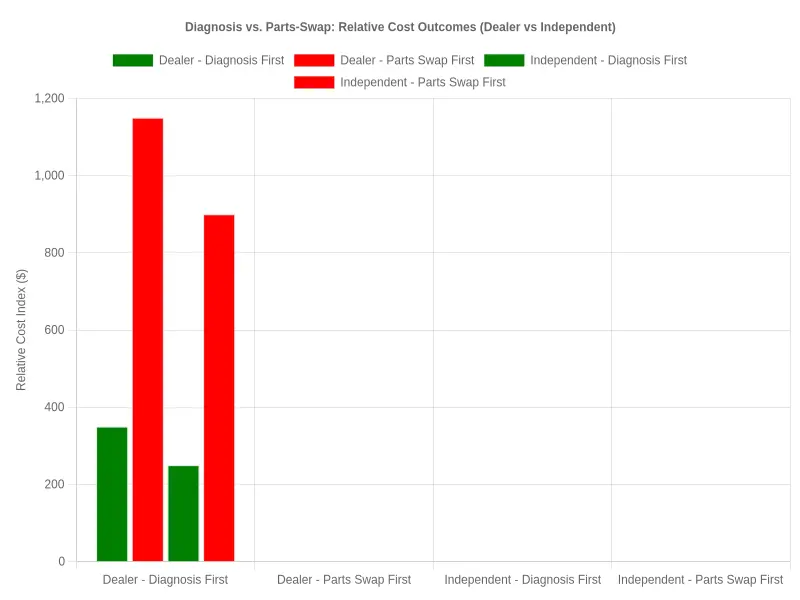
The diagnosis-first bar is the lowest in both the dealer and independent columns, because you pay for an accurate answer once instead of bankrolling a string of guesses. Diagnosis is the cheapest long-term path whichever shop performs it. The parts-swap-first route inflates total spend the most when the guessed component turns out to be wrong, a lesson that also shapes smarter maintenance budgeting.
Documentation, Communication, and Customer Trust
An intermittent derate tests a shop’s credibility as much as its technical skill. When a truck throws a fault code once, then runs clean for two weeks, the customer wonders whether anything was actually wrong – or whether they’re being sold a repair they didn’t need. That is where the dealer versus independent shop decision is often won or lost, and it rarely comes down to who owns the fancier scan tool. It comes down to who can prove their reasoning.
Why diagnostic documentation justifies the repair
Thorough diagnostic documentation turns a repair from a guess into a record. When a truck rolls in with an intermittent derate, capture the fault codes with timestamps, note the operating conditions (load, ambient temperature, duty cycle), and save the freeze-frame data. Photograph suspect connectors, chafed harnesses, and corroded pins before you touch them. Pull and store the datalog so the next technician – or the next visit – starts from evidence rather than a hunch.
That paper trail does two things. It justifies the repair to the customer: you can show the exact moment the sensor dropped out instead of just telling them it did. It also protects the shop if the fault returns. If the derate comes back six weeks later on the same circuit, your notes show what was tested, what was replaced, and what the fault looked like the first time – the difference between a warranty argument and a loyal customer.
Documentation must-dos
A short checklist worth adopting on every intermittent fault:
- Log fault codes with timestamps and freeze-frame data before clearing anything.
- Photograph connectors, harness routing, and any corrosion or chafe.
- Save the datalog and attach it to the repair order, not just the scan tool.
- Write a plain-language note explaining what was ruled out and why.
Clear communication builds repeat business
How you explain a repair matters as much as the repair itself. Tell the customer why a part was replaced, and just as importantly why one wasn’t. If you tested a $600 sensor and it passed, say so, and explain what you did instead. That honesty turns a one-time emergency into a standing relationship, and it is a big reason customers stick with an independent shop after a frustrating round of guesswork elsewhere.
Fleet-focused shops can borrow documentation habits straight from established fleet programs, which live and die by record-keeping. The maintenance discipline behind these fleet maintenance tips and the planning mindset in right-sizing a small fleet apply directly to the service bay. Put the same care into a single truck’s records that a fleet manager puts into a hundred-unit program, and intermittent-derate diagnostics stop being a coin flip. Good communication keeps customers coming back, whether the truck first arrived under a dealer or an independent banner.
Frequently Asked Questions About Diagnosing an Intermittent Derate
Is a dealer always better at diagnosing an intermittent derate?
No. Dealers have factory software and the freshest training, but an intermittent derate usually comes down to how much seat time and diagnostic technique a technician applies, not which logo is on the building. Many experienced independent shops run the same OEM-grade scan tools and follow the same fault tree the dealer uses. The dealer versus independent shop decision should hinge on the specific fault, the tooling, and the technician’s skill, not brand loyalty.
How long should a diagnosis take before replacing parts?
As a general rule, a technician should confirm a fault, capture the relevant data, and document a repair recommendation within a two-to-four-hour diagnostic window. If a shop is still guessing and swapping parts past that point without captured evidence, it is time to step back and reassess the approach. Replacing components “just to see” is the most expensive way to handle an intermittent derate, because it replaces evidence with speculation.
What if the derate never appears during a shop visit?
Intermittent faults rarely fail on command, so aim to capture data rather than force the symptom. Set the vehicle up with a data logger or flight recorder, review freeze-frame and event data, and give the driver clear instructions on what to note when it happens. Sometimes the most valuable outcome of a first visit is not a repair but a sharper description of when and how the derate occurs.
Can an independent shop access OEM fault data?
Yes, in most cases. Through OEM subscriptions, J2534 pass-through devices, and third-party service information platforms, independent shops can pull the same fault codes, technical service bulletins, and diagnostic procedures the dealer relies on. The barrier is usually the subscription cost and the time to stay current, not access itself. A well-equipped shop with strong in-house maintenance strategies can match the factory tooling for diesels and medium-duty trucks.
When should a vehicle actually be sent to a dealer?
Send it to a dealer when the fault requires a factory software recalibration, a warranty repair, an immobilizer or module programming function the scan tool cannot reach, or a brand-new platform where bulletins and known fixes have not yet reached the aftermarket. If the vehicle is still under warranty, the dealer is usually the right first stop to protect coverage. For everything else, a capable independent shop can often diagnose faster without the dealer’s scheduling backlog.
How do I explain the diagnostic bill to a customer?
Explain that diagnostics is skilled labor, not a free estimate, and that the time billed bought testing, data, and a documented conclusion rather than a guess. Break the bill into visible line items such as scan time, road test, wiring checks, and data review. When a proper diagnosis prevents an unnecessary parts cannon, it often saves the customer far more than the diagnostic fee itself.